① Cambodia: The Only Flag with a Building
🇰🇭 Kingdom of Cambodia
Adopted: 1948 (current design 1993)
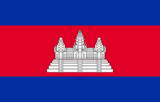
The white structure in the center is Angkor Wat — the world's largest religious monument. Cambodia is the only country in the world whose flag depicts a specific building. It represents the height of Khmer civilization and remains a source of immense national pride.
Built in the 12th century by King Suryavarman II as a Hindu (later Buddhist) temple complex, Angkor Wat has appeared on every version of Cambodia's flag throughout colonial rule, civil war, and reconstruction. The silhouette is so intricate that hand-drawn versions frequently come out misshapen — it's considered one of the hardest flags to draw accurately.
💡 Bonus fact: Angkor Wat faces west — the direction associated with death in Hinduism — leading some scholars to believe it was designed as a funerary temple. The debate continues today.
② Cyprus: A Country Whose Flag Shows Its Own Map
🇨🇾 Republic of Cyprus
Adopted: 1960 (at independence)
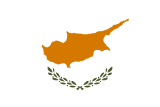
The orange shape on the white field is the island of Cyprus itself. Below it, two olive branches cross in a symbol of peace. Cyprus and Kosovo are the only two countries in the world to depict their own map on their national flag.
When Cyprus gained independence from Britain in 1960, tensions between Greek Cypriot and Turkish Cypriot communities were already severe. Neither Greek blue-and-white nor Turkish red-and-white could be used without inflaming one side — so the island's shape became the neutral symbol of unity. The orange color represents copper, the metal for which Cyprus was famous in antiquity (the word "copper" actually derives from the Latin name for Cyprus: Cuprum).
Since 1974, Turkey has occupied the northern third of the island. The flag's full map of Cyprus remains, to this day, an aspiration as much as a description.
③ Mozambique: The Flag with an AK-47
🇲🇿 Republic of Mozambique
Adopted: 1983 (current design)
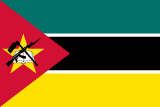
Inside the red triangle on the left sits a design of an AK-47 assault rifle, a hoe, and an open book. Mozambique is the only country in the world with a small arm currently depicted on its national flag. The rifle represents the armed struggle for independence, the hoe stands for agriculture, and the book for education.
Mozambique gained independence from Portugal in 1975, and FRELIMO (the Mozambique Liberation Front) took power. The AK-47 was embedded in the flag as a symbol of liberation and has remained ever since — despite ongoing international and domestic debate about whether a modern nation should feature a firearm on its flag. A 2005 design competition was held, and rifle-free designs were submitted, but the current design was ultimately retained.
💡 Bonus fact: The AK-47 on Mozambique's flag is also depicted on the country's coat of arms and appears on several banknotes — making it one of the most consistently featured symbols in the country's visual identity.
④ Portugal: The Age of Exploration Hidden in Plain Sight
🇵🇹 Portuguese Republic
Adopted: 1911 (current design)
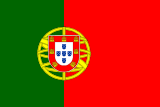
Behind the coat of arms at the junction of green and red sits a golden sphere: the armillary sphere — a navigational instrument used by Portuguese explorers during the Age of Discovery. It guided Vasco da Gama to India and supported Magellan's circumnavigation of the globe.
Portugal once controlled one of the largest maritime empires in history, with territories spanning Africa, Brazil, India, and Southeast Asia. The armillary sphere represents that era of exploration — the ability to "measure and navigate the world." Within the coat of arms, the five blue shields recall victories over Moorish forces, and the seven red castles represent conquered strongholds.
⑤ Brazil: A Flag That Froze a Moment in Time
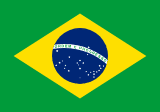
🇧🇷 Federative Republic of Brazil
Adopted: 1889 (current design)
The 27 stars in the blue circle represent Brazil's 26 states plus the Federal District. Their arrangement is not random: it is a precise map of the night sky over Rio de Janeiro on November 15, 1889, at 8:30 a.m. — the exact moment the Brazilian Republic was proclaimed.
The banner across the blue globe reads "ORDEM E PROGRESSO" (Order and Progress), drawn from the positivist philosophy of French thinker Auguste Comte. Brazil's flag is essentially a compressed snapshot of a historical moment: a specific philosophy, a specific date and time, and the geography of an entire nation — all on one piece of cloth. Stars have been added as new states were created, with the last update in 1992 bringing the total to 27.
⑥ Sri Lanka: Buddhist Leaves and a Royal Lion
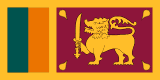
🇱🇰 Democratic Socialist Republic of Sri Lanka
Adopted: 1978 (current design)
The golden lion holds the Sword of King Kasyapa. The four Bo leaves (Bodhi tree leaves) in the corners represent Buddhism. The green stripe represents Muslims, the orange stripe represents Hindus (Tamil people) — the flag encodes the country's entire religious makeup in a single design.
Sri Lanka's flag is a visual constitution of its multi-religious, multi-ethnic society. The Sinhalese Buddhist majority, Tamil Hindu minority, and Muslim community are each given symbolic space. During the civil war (1983–2009), the Lion Flag was criticized by Tamil groups as a symbol of Sinhalese dominance — a reminder that national symbols always carry political weight.
⑦ Papua New Guinea: A Bird of Paradise and the Southern Cross
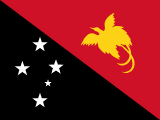
🇵🇬 Independent State of Papua New Guinea
Adopted: 1971 (two years before independence)
The bird on the black field is the raggiana bird-of-paradise, a species endemic to Papua New Guinea whose feathers were historically prized in trade. The Southern Cross on the red field marks the country's position in the southern hemisphere. The designer was a 15-year-old schoolgirl who hand-painted the final version after her design was selected.
Papua New Guinea is the most linguistically diverse country on earth, with over 850 languages. The bird-of-paradise transcended ethnic and regional divisions — it was recognized and admired throughout the country. Today it appears on the national emblem, the national airline's livery, and stamps.
⑧ Belize: The Only Flag with Human Figures
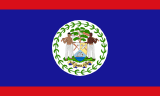
🇧🇿 Belize
Adopted: 1981 (at independence)
Inside the central coat of arms stand two human figures — one mestizo, one of European descent — each holding tools of the logging industry. Belize is the only country whose flag depicts full human figures facing forward. The mahogany tree behind them recalls the country's historical timber trade.
Formerly known as British Honduras, Belize is a small Central American nation whose economy was built on logging — particularly mahogany, which was exported throughout the British Empire. The two figures represent different ethnic groups working together, visualizing the nation's multicultural identity. The motto above reads "Sub Umbra Floreo" — "Under the shade I flourish" — a direct reference to the mahogany canopy.
⑨ Nepal: The Only Non-Rectangular National Flag
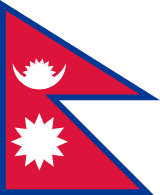
🇳🇵 Federal Democratic Republic of Nepal
Adopted: 1962 (current design; shape predates this by centuries)
Nepal's flag is the only national flag in the world that is neither rectangular nor square. The double-pennant shape originates from two triangular pennants historically flown together — one for the king, one for the prime minister. The upper triangle bears a white moon (symbolizing calm, like the Himalayas), the lower bears a white sun (symbolizing courage). The crimson red is the color of the rhododendron, Nepal's national flower.
At international events, Nepal's flag routinely draws questions about its unconventional shape. The government has no plans to change it — the shape is considered part of the nation's cultural heritage. The flag's exact proportions are defined by mathematical formula in national law, ensuring geometric precision despite the unusual form. The sun-and-moon combination carries the wish that Nepal will endure as long as those celestial bodies — a sentiment woven into Nepalese culture for centuries.
Test your flag knowledge!
Can you identify these flags at a glance?
Filter by region and find out.
Reading Flags as Stories
Each of these nine flags tells a story that a simple color description would never capture. A building that survived colonial rule. An island still waiting to be whole. A bird that unites 850 languages. A sky frozen at the exact moment a republic was born. When you start reading flags this way — not as color combinations to memorize, but as compressed histories to understand — the world becomes a more interesting place. And you'll find that the flags you once mixed up are suddenly impossible to forget.